Diabetes can affect the feet in ways that are easy to overlook at first. A small area of pressure, a minor blister, or a change in the way you walk may seem insignificant. However, when diabetes is associated with reduced sensation, poor circulation, foot deformity, or changes in the structure of the foot, a small problem can develop into a serious wound.
The good news is that many diabetic foot complications can be prevented or managed through regular foot care, appropriate footwear, pressure management, and professionally prescribed orthotic solutions.
Orthotics—including customized insoles, pressure-relieving offloading devices, and CROW (Charcot Restraint Orthotic Walker) boots—can play an important role in reducing excessive pressure, protecting vulnerable areas, supporting the foot, and helping patients maintain mobility.
Why Diabetes Can Put Your Feet at Risk
Diabetes can affect the feet through several mechanisms. One of the most important is diabetic peripheral neuropathy, which can reduce the ability to feel pain, pressure, heat, or injury.
Normally, if your shoe is rubbing against your foot or a particular area is experiencing excessive pressure, discomfort encourages you to change your position or remove the shoe. With reduced sensation, that warning system may not work properly.
A person may continue walking on an injured area without realizing it.
Diabetes can also affect circulation. Reduced blood flow can make it more difficult for damaged tissue to receive oxygen and nutrients needed for healing. In addition, foot deformities, limited joint movement, calluses, previous ulcers, and inappropriate footwear can further increase pressure on specific areas of the foot.
This combination can create a dangerous cycle:
Excessive pressure → tissue damage → ulceration → delayed healing → infection → potentially serious complications. For this reason, preventing excessive pressure is one of the most important principles of diabetic foot care.
Common Diabetic Foot Complications
Diabetic foot problems can vary considerably from one person to another. Some of the most common complications include:
1. Loss of protective sensation
Neuropathy may cause numbness, tingling, burning, or reduced sensation. Some people may have significant nerve damage without experiencing much pain.
This is why relying only on pain as a warning sign can be dangerous.
2. Calluses and areas of high pressure
Calluses frequently develop over areas exposed to repeated mechanical stress. A callus itself may not be dangerous, but it can indicate that excessive pressure is being concentrated in that particular area.
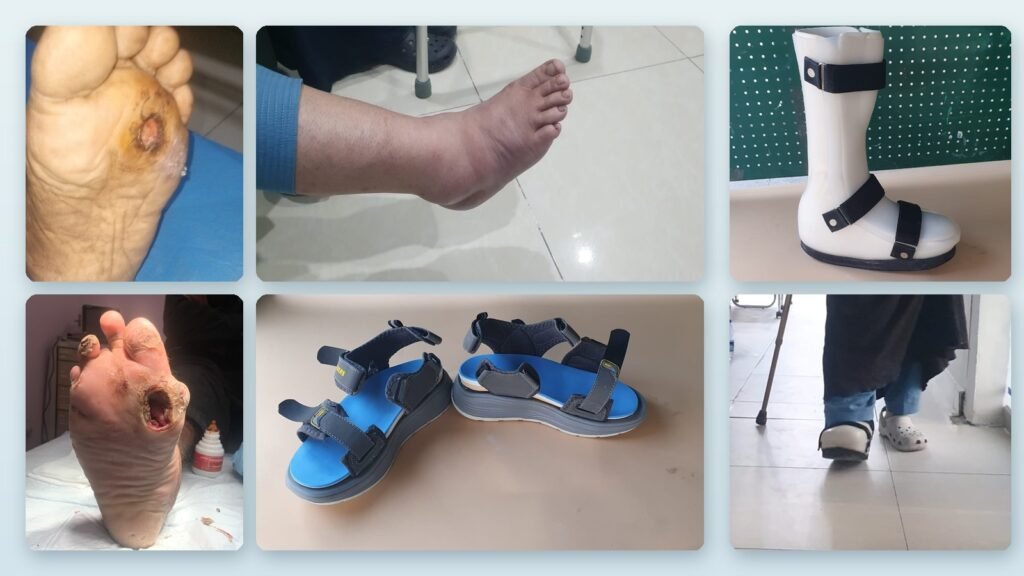
3. Diabetic foot ulcers
An ulcer is an open wound, commonly occurring beneath the forefoot, heel, or other areas exposed to repetitive pressure.
Once an ulcer develops, simply covering the wound is usually not enough. The mechanical forces contributing to the wound must also be addressed.
4. Foot deformity
Conditions such as claw toes, prominent metatarsal heads, hallux deformity, limited ankle movement, or other structural changes can alter the distribution of pressure beneath the foot.
5. Charcot foot
Charcot neuroarthropathy is a particularly serious complication associated with neuropathy. It can cause inflammation, bone and joint destruction, instability, and progressive changes in the shape of the foot.
Without appropriate management, a Charcot foot can develop a rocker-bottom type deformity, creating areas of very high plantar pressure and increasing the risk of ulceration.
Where Orthotics Fit Into Diabetic Foot Care
Orthotic treatment is not simply about making a comfortable insole or supplying a special shoe.
For a person with diabetes, an orthotic device should be considered as part of an overall pressure-management and foot-protection strategy.
The objective is to understand:
- Where pressure is occurring
- Why pressure is occurring
- How the patient’s foot structure affects loading
- Whether there is neuropathy or vascular compromise
- Whether there is an existing ulcer or previous ulcer history
- Whether there is a deformity such as Charcot foot
- What footwear the patient uses
- How the patient walks and performs daily activities
The orthotic solution should then be designed around these findings.
Customized Insoles for Diabetic Feet
Customized insoles are among the most commonly used orthotic solutions for people with diabetes.
A well-designed diabetic insole can help redistribute plantar pressure away from vulnerable areas and provide cushioning and support where appropriate.
However, a customized insole is not simply a soft piece of foam.
Its design may consider the patient’s:
- Foot shape
- Pressure distribution
- Deformities
- Metatarsal position
- Heel loading
- Range of motion
- Gait pattern
- Previous ulcer locations
- Footwear requirements
Materials can also be selected according to the individual’s needs. Depending on the case, combinations of cushioning, pressure-distributing, and more supportive materials may be used.
The goal is pressure redistribution, not simply softness.
The correct An excessively soft insole may feel comfortable initially but may not adequately control abnormal loading. Conversely, an overly rigid or poorly fitted device can create new pressure points.
balance depends on the patient’s individual foot and clinical condition.
For patients with a history of diabetic ulcers, regular review is particularly important because the foot can change over time and the orthotic device may require modification.
Offloading Orthotics: Reducing Pressure From an Injured Area
When a diabetic patient develops a high-risk pressure area or ulcer, offloading becomes a central part of treatment.
Offloading means reducing or removing mechanical stress from the affected area so that the tissue has an opportunity to heal.
Depending on the location and severity of the problem, different approaches may be considered.
These can include:
- Customized footwear
- Modified insoles
- Forefoot or heel offloading devices
- Orthotic walkers
- Total contact-type devices
- Customized braces
- Other professionally prescribed pressure-relieving solutions
The choice depends on the patient’s wound, foot shape, mobility, vascular status, neurological status, and ability to follow the treatment plan.
An important principle is that an offloading device must be effective and usable. A technically excellent device that a patient cannot tolerate or does not use consistently will not provide the intended benefit.
CROW Boot for Charcot Foot
For patients with Charcot neuroarthropathy, a CROW boot can be an important orthotic management option during appropriate stages of treatment and rehabilitation.
CROW stands for Charcot Restraint Orthotic Walker.
It is a custom-made, rigid or semi-rigid enclosed orthotic device designed to protect and stabilize the foot and ankle while helping distribute pressure more evenly.
A CROW boot may be considered when the foot has significant deformity, instability, or a history of Charcot-related changes and requires long-term protection.
The device typically encloses the foot and lower leg, providing a protective environment around the affected area.
What can a CROW boot help achieve?
A properly designed CROW can help:
- Reduce localized plantar pressure
- Protect vulnerable areas from repetitive trauma
- Improve stability
- Accommodate significant foot deformity
- Reduce abnormal loading during walking
- Protect a previously ulcerated foot
- Provide a transition toward longer-term protective footwear in appropriate cases
Because Charcot feet can have highly irregular shapes, a standard commercial device may not provide adequate accommodation. A custom approach allows the orthotist to address the individual’s anatomy and pressure-sensitive areas.
Why Proper Fitting Matters
Even the most advanced orthotic technology cannot replace proper assessment and fitting.
For diabetic patients, a small area of excessive pressure can have significant consequences—particularly when protective sensation is reduced.
The orthotist should carefully evaluate the foot, footwear, alignment, pressure areas, and functional requirements.
The patient’s feedback is also important.
After receiving an orthotic device, the foot should be monitored for:
- Redness
- Skin irritation
- Blisters
- New calluses
- Swelling
- Areas of increased pressure
Prevention Is Better Than Waiting for an Ulcer
One of the most important messages for people with diabetes is that orthotic care should not necessarily begin after an ulcer develops.
For patients who have neuropathy, deformity, previous ulcers, calluses, or other risk factors, early assessment can help identify pressure problems before they become wounds.
Regular foot inspection is also essential.
Patients should check their feet every day for cuts, redness, swelling, blisters, cracks, changes in skin condition, or other abnormalities. Because neuropathy can reduce sensation, visual inspection is especially important.
Footwear should also be checked regularly. The inside of the shoe should be free from objects, rough areas, folds, or anything that could create excessive pressure.
A Personalized Approach to Diabetic Foot Protection
There is no single orthotic device that is appropriate for every person with diabetes.
One patient may benefit from a customized insole and therapeutic footwear. Another may require a more substantial offloading device. A patient with Charcot deformity may require a custom CROW boot.
The important question is not simply:
“Which device should I use?”
It is:
“What is causing excessive pressure or instability, and what is the safest way to manage it?”
A detailed assessment helps answer that question.
Frequently Asked Questions About Diabetic Foot Orthotics
1. Can a diabetic patient use customized insoles?
Yes. Customized insoles are commonly used to help redistribute pressure and accommodate individual foot shape and deformities. They may be particularly useful for people with neuropathy, calluses, previous ulcers, or areas of excessive plantar pressure.
However, the design should be based on an individual assessment rather than simply using a generic diabetic insole.
2. Can customized insoles prevent diabetic foot ulcers?
Customized insoles can help reduce excessive or abnormal plantar pressure and may form an important part of ulcer-prevention strategies for appropriately selected patients.
However, no insole can guarantee that an ulcer will not develop. Daily foot inspection, appropriate footwear, diabetes management, regular clinical review, and addressing other risk factors remain important.
3. What is an offloading orthotic?
An offloading orthotic is a device designed to reduce mechanical pressure and shear forces on a specific area of the foot.
It may be used when a patient has a high-risk pressure area, callus, wound, ulcer, or other condition where reducing mechanical loading is important for tissue protection or healing.
4. What is a CROW boot?
Not necessarily. A CROW boot may be used in different stages of Charcot foot management depending on the patient’s clinical condition.
It can be used to protect and stabilize a deformed or vulnerable foot and, in appropriate cases, to help protect the foot after an ulcer has healed.
The decision should be made by the treating clinical team based on the individual’s condition.
6. Are soft insoles always better for diabetic feet?
No. Softer does not automatically mean safer.
An orthotic needs to provide an appropriate combination of cushioning, pressure redistribution, accommodation, and support. An excessively soft material may compress under load and may not adequately control pressure.
The material selection should be based on the individual’s foot condition, activity, footwear, and risk factors.
7. How often should diabetic insoles be replaced?
There is no single replacement interval that applies to everyone. The lifespan depends on the materials, the patient’s activity level, body weight, footwear, and the condition of the insole.
More importantly, the insole should be inspected regularly. If it becomes compressed, damaged, distorted, or no longer provides the intended support or accommodation, it may need replacement or modification.
8. Can a person with a diabetic foot ulcer continue walking normally?
This depends on the location and severity of the ulcer and the treatment plan prescribed by the healthcare team.
Walking repeatedly on an ulcer or high-pressure area can interfere with healing. Appropriate offloading is often an important part of treatment.
A patient with an active ulcer should receive professional assessment rather than attempting to determine the appropriate level of weight-bearing independently.
9. What should I do if my orthotic causes redness?
Remove the device and have the area assessed, particularly if the redness persists, becomes painful, develops into a blister, or is associated with broken skin.
People with reduced sensation may not feel an injury developing, so new or persistent skin changes should be taken seriously.
The orthotic may need modification to remove the source of excessive pressure.
10. Can orthotics help a person with Charcot foot walk more safely?
Not necessarily. Orthotic treatment should be based on individual risk and clinical findings.
A person with low foot risk may not require custom orthotics, while someone with neuropathy, deformity, previous ulceration, abnormal pressure, or Charcot changes may benefit from specialized orthotic management.
11. Should every person with diabetes have custom orthotics?
Not necessarily. Orthotic treatment should be based on individual risk and clinical findings.
A person with low foot risk may not require custom orthotics, while someone with neuropathy, deformity, previous ulceration, abnormal pressure, or Charcot changes may benefit from specialized orthotic management.
12. When should someone with diabetes see an orthotist?
An orthotic assessment may be particularly useful if you have:
- Recurrent calluses
- Numbness or reduced sensation
- Foot deformity
- Previous diabetic foot ulcer
- Charcot foot
- Abnormal walking pattern
- Difficulty finding appropriate footwear
- Recurrent pressure or skin problems
- A need for specialized offloading
Early assessment can help identify mechanical problems before they develop into more serious complications.
Final Thoughts
Diabetic foot complications can have a major impact on mobility, independence, and quality of life. In severe cases, untreated ulcers and infections can lead to hospitalization and amputation.
But many complications can be reduced through early recognition, regular foot monitoring, appropriate footwear, pressure management, and coordinated clinical care.
Customized insoles, offloading orthotics, and CROW boots are valuable tools in this process. When properly assessed, designed, fitted, and monitored, they can help protect vulnerable feet, redistribute pressure, accommodate deformities, and support safer mobility.
If you have diabetes and experience numbness, recurrent calluses, foot deformity, a previous ulcer, Charcot foot, or difficulty finding comfortable and protective footwear, consider having your feet professionally assessed by an appropriate healthcare professional.
Protecting the diabetic foot starts before a small problem becomes a serious one.
This article is intended for general educational purposes and does not replace an individual clinical assessment or medical advice. People with diabetes who have an open wound, signs of infection, sudden swelling or warmth, or a rapidly changing foot should seek prompt professional medical evaluation.