Curve measurement, growth staging and custom bracing explained for parents and clinicians
Quick Answer
Adolescent idiopathic scoliosis (AIS) is a sideways and rotational curve of the spine that appears between about 10 and 18 years of age with no known cause. Doctors confirm it when the Cobb angle on an X ray reaches 10 degrees or more. Growing teens with curves of roughly 25 to 40 degrees are often fitted with a custom brace to stop the curve getting worse while they grow.
Key Takeaways
- Scoliosis affects the spine in three planes. It is more than a side bend.
- The Cobb angle tells you the size of the curve. It does not tell you the risk of it getting worse.
- Remaining growth, measured with the Risser sign or Sanders staging, drives the treatment decision.
- A brace aims to hold the curve during growth. It does not permanently straighten the spine.
- Results depend heavily on how many hours a day the teen actually wears the brace.
Many parents first notice something small. One shoulder sits higher than the other. A shoulder blade sticks out. The waist looks uneven in a fitted shirt. For other families, a school screening or a routine check picks it up.
The diagnosis often comes as a shock. The good news is that most curves are mild, and growing teens with moderate curves have a proven, nonsurgical option in bracing. This guide covers how the curve is measured, how growth is staged, and how an orthotist designs a brace that fits the individual spine.
What Is Adolescent Idiopathic Scoliosis?
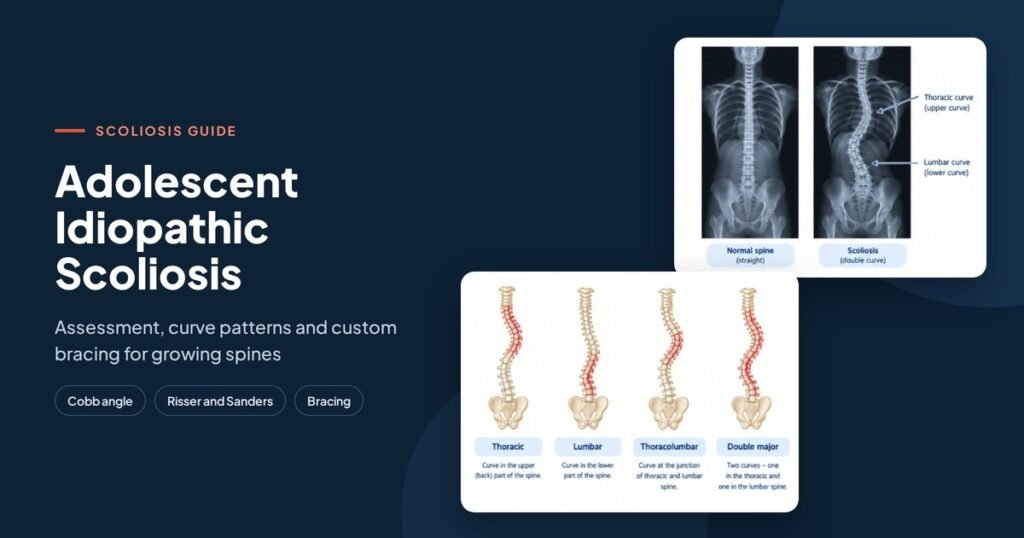
Adolescent idiopathic scoliosis is a structural curve of the spine of at least 10 degrees, measured by the Cobb method, combined with rotation of the vertebrae. It develops during adolescence and has no identified cause. “Idiopathic” simply means the cause is unknown.
AIS usually shows up during the growth spurt. Researchers have studied genetic, hormonal, neurological and biomechanical factors. No single cause explains every case.
Before calling a curve idiopathic, the clinician rules out other causes. These include:
- Congenital problems with the vertebrae
- Neuromuscular conditions such as cerebral palsy or muscular dystrophy
- Spinal cord abnormalities
- Tumours or infection
- Genetic syndromes
This is why a full clinical examination comes first.
Why Does Scoliosis Get Worse During the Teenage Years?
A curve is most likely to grow when the spine is growing fastest. The teenage growth spurt is the highest risk period. Curve size, age, skeletal maturity, curve pattern and any earlier increase all affect the risk.
Two teens with the same Cobb angle can need very different care. A 25 degree curve in a child with years of growth ahead needs closer watching than the same curve in a teen who has nearly stopped growing.
Levoscoliosis vs Dextroscoliosis: What Is the Difference?
Dextroscoliosis is a curve that bends toward the patient’s right side. Levoscoliosis bends toward the left. The terms describe direction only. They say nothing about how severe the curve is or whether a brace is needed.
A right thoracic dextroscoliosis is a curve in the upper back that points to the right. A left lumbar levoscoliosis is a curve in the lower back that points to the left.
Direction matters when planning a brace. A right thoracic curve, a left lumbar curve and a combined thoracolumbar curve each need a different correction plan. Still, the orthotist also has to look at curve size, rotation, flexibility, the side profile of the spine, the pelvis and remaining growth.
What Is the Cobb Angle?
The Cobb angle is the standard X ray measurement of scoliosis. The clinician finds the most tilted vertebrae at the top and bottom of the curve, draws lines along their end plates, and measures the angle between those lines in degrees. A reading of 10 degrees or more confirms scoliosis.
Clinicians use the Cobb angle to confirm the curve, grade its size, track change over time and decide between observation and bracing. It also shows how well a brace corrects the curve.
Curves under 10 degrees usually count as spinal asymmetry rather than true structural scoliosis.
Why the Cobb angle alone is not enough
The number tells you how big the curve is today. It does not tell you how much the teen will still grow or how fast the curve might change. A 30 degree curve in a fast growing 11 year old carries more risk than a stable 30 degree curve in a 17 year old.
Small changes between two X rays can also come from posture or measurement error. Consistent imaging and side by side comparison with older films help avoid false alarms.
A Cobb angle is a measurement. It is not a treatment plan.
What Is the Adams Forward Bend Test?
The Adams forward bend test is a quick clinical screen for scoliosis. The patient bends forward at the waist with arms hanging loose while the examiner looks along the back for a rib hump, a lumbar bulge or uneven shoulder blades. A scoliometer can measure the angle of trunk rotation.
The examiner looks for:
- A rib prominence on one side
- A bulge in the lower back
- Uneven shoulder blades or waistline
- Visible rotation of the trunk
The rib hump forms because the vertebrae rotate and pull the attached ribs with them. That is the clearest sign that scoliosis is a three dimensional problem.
A positive test means the teen needs further assessment. It does not give a Cobb angle and cannot confirm the diagnosis on its own. An X ray is still required.
How Is Skeletal Maturity Measured?
Clinicians use two main tools. The Risser sign grades bone development of the pelvis on a scale of 0 to 5. The Sanders scale grades the bones of the hand on a scale of 1 to 8. Lower scores on either scale mean more growth is left and the curve carries more risk of progressing.
The single most useful question in teen scoliosis is simple. How much growing does this child have left? The answer shapes both the risk and the case for a brace.
The Risser sign
The Risser sign looks at the growth plate along the top of the pelvis (the iliac apophysis) on an X ray.
- Risser 0: no visible bone formation
- Risser 1: about a quarter formed
- Risser 2: about half formed
- Risser 3: about three quarters formed
- Risser 4: fully formed but not yet fused
- Risser 5: fully fused, growth complete
A teen at Risser 0 to 2 usually has meaningful growth ahead. The sign has one weakness. It can miss the exact timing of the peak growth spurt.
The Sanders Maturity Scale
The Sanders scale reads the small bones of the hand and fingers on a hand X ray. It runs from stage 1 to stage 8, where stage 8 means growth is complete.
Sanders staging gives a sharper picture during the rapid growth phase than the Risser sign. For the orthotist, it helps decide how urgently to brace, how long treatment may last, how often to review the teen and when the brace will need changes.
Neither scale works alone. Both should be read alongside age, growth history, the clinical exam and any change in the curve.
What Is L4 Tilt and Why Does It Matter for Bracing?
L4 tilt is the angle of the fourth lumbar vertebra in the frontal plane. It shows how the lower spine sits on the pelvis. Research on custom braces has linked an L4 tilt above 10 degrees with less correction inside the brace, so orthotists factor it into lumbar brace design.
The lower lumbar spine has a big say in overall balance. When a teen has a lumbar or thoracolumbar curve, the brace has to account for how the thoracic spine, lumbar spine, pelvis and trunk connect.
For these patients the orthotist checks lumbar curve size and rotation, pelvic position, trunk shift, L4 angle, thoracolumbar balance and the side profile of the spine.
A recent study on CAD/CAM braces compared teens with an L4 tilt of 10 degrees or less against those above 10 degrees. The higher tilt group gained less correction in the brace. A high L4 tilt does not rule out bracing, and it does not mean treatment will fail. It is one more input for the design.
The better question for the orthotist is not where to push on the lumbar curve. It is how the lumbar curve, L4 angle, pelvis, trunk shift and thoracic curve work together in this one patient.
When Is a Scoliosis Brace Recommended?
A brace is usually considered for teens who are still growing and have a curve of about 25 to 40 degrees. Smaller curves are often watched, sometimes with scoliosis specific exercise. Larger or fast growing curves need a specialist review for other options.
These ranges are a guide, not a rule. The care team weighs:
- Cobb angle and curve pattern
- Age and skeletal maturity
- Any recent increase in the curve
- Vertebral rotation and trunk balance
- What the teen and family want
- Whether the teen can realistically follow the wearing schedule
What Does a Scoliosis Brace Actually Do?
The main goal of a brace is to stop the curve getting bigger while the teen grows. The brace often straightens the spine while it is worn, but that correction is temporary. Success means the curve stays at an acceptable size by the time growth ends.
Parents often hope the brace will remove the curve for good. Setting the right expectation early avoids disappointment later. Bracing controls progression. It does not permanently reshape the spine.
How Does 3D Brace Correction Work?
Modern bracing treats scoliosis as a 3D deformity. Pushing on the side of the curve is only part of the job.
Frontal plane
This is the side bend you see on an X ray. The brace works to reduce it and bring the trunk back over the pelvis.
Rotational plane
Rotation of the vertebrae creates the rib hump and lumbar bulge. Well placed pressure pads and open expansion areas inside the brace help counter this twist.
Side profile
Seen from the side, a healthy spine has a gentle curve in the upper back and an inward curve in the lower back. A good brace protects these curves instead of flattening them.
Trunk shift and balance
Some teens have a torso that sits off to one side of the pelvis. The brace can guide the trunk back toward the centre while leaving room to breathe and move.
What Types of Scoliosis Brace Are There?
Thoracolumbosacral orthosis (TLSO)
The TLSO is the most common brace family for AIS. It wraps the trunk from the pelvis upward and applies corrective forces while leaving room for breathing and daily movement.
Boston brace
The Boston brace is a long established TLSO. It uses a more symmetrical shell with pads placed at key points.
Rigo-Cheneau brace
The Rigo-Cheneau design is asymmetric and built for 3D correction. It uses pressure zones, open expansion chambers, derotation and trunk shift, all shaped to the individual curve. Because it is so specific, the design for one curve pattern may not suit another.
Night time braces
Providence and Charleston braces are worn mainly during sleep. They can suit selected patients depending on curve size, flexibility and growth. The care team should choose between full time and night time wear on clinical grounds, not convenience.
How Is a Custom Scoliosis Brace Designed?
Good bracing starts before any scan or cast. The orthotist studies the X rays and the clinical findings first and builds a correction plan from them.
Key details from the X ray include:
- Cobb angle, end vertebrae and the apical vertebra
- Curve direction and pattern
- Vertebral rotation and trunk shift
- Pelvic alignment and L4 tilt
- Upper back and lower back profile
- Skeletal maturity
- Curve flexibility, where bending films are available
Standing films show how the spine behaves under load. Bending films show how flexible the curve is and how much correction may be possible.
Why every brace must be individual
A scoliosis brace is not a standard plastic shell. Its forces have to match the location, direction and rotation of the curve, and the way the trunk sits on the pelvis. CAD/CAM software helps produce accurate custom braces, but it does not replace clinical judgement.
How Is In Brace Correction Measured?
An X ray is taken while the teen wears the brace. The team compares the Cobb angle in the brace with the angle before bracing. Correction (%) = (Cobb angle before brace minus Cobb angle in brace) divided by Cobb angle before brace, multiplied by 100.
Example: a curve measures 32 degrees before bracing and 12 degrees in the brace. The correction is (32 minus 12) divided by 32, multiplied by 100, which equals 62.5%.
A high figure shows the brace is working mechanically. It does not guarantee a good long-term result. Growth, daily wear time and the nature of the curve all play a part.
Brace Fit and Comfort
A well designed brace can still fail if it is uncomfortable or hard to wear. At each fitting the orthotist checks:
- How well the brace holds the pelvis
- Where the pressure falls and how it spreads
- Expansion areas and trim lines
- Skin condition and breathing comfort
- Sitting, walking and fit under clothing
- How easily the teen can put the brace on and take it off
Ongoing skin redness, pain, pressure sores or breathing trouble need prompt review and brace adjustment.
Why Does Brace Wear Time Matter So Much?
Wear time is one of the strongest predictors of success. The BrAIST trial (New England Journal of Medicine, 2013) found that bracing cut the risk of curves reaching surgical size in suitable teens, and that teens who wore the brace for more hours each day had better results.
Wearing a brace for long hours is hard for a teenager. School, sport, clothing, friends and body image all affect how willing they are to wear it. Treatment has to include education and emotional support, not just the device.
Orthotists and doctors should help families build realistic daily routines, fix discomfort early and explain the purpose of the brace in words the teen understands.
Follow Up Appointments and Growth Changes
Bracing is an ongoing process. The teen keeps growing, so the brace needs regular review. Follow up visits usually check:
- Height, weight and growth rate
- Brace fit, pressure areas and skin
- Comfort and the actual wearing schedule
- Wear and tear on the brace
- Trunk balance and X ray progress
A brace that fits well at the start may need adjustment or a replacement as the teen grows. Regular contact between the family, orthotist, orthopaedic specialist and physiotherapist keeps treatment on track.
Can Scoliosis Exercises Help?
Scoliosis specific exercises can support treatment by improving postural awareness, active self correction, trunk control and breathing. They should be taught by a trained therapist. For a teen who meets the criteria for bracing, exercise supports the brace but should not replace it.
When Is Observation the Right Choice?
Not every teen with scoliosis needs a brace. Observation suits many smaller curves, especially in teens near the end of growth with no sign of the curve increasing.
Observation means planned check ups, not doing nothing. The team tracks the Cobb angle, growth, skeletal maturity, trunk asymmetry and any new symptoms.
When Is Surgery Considered?
Surgery is usually discussed when a curve approaches or passes about 45 to 50 degrees, especially if it is still increasing. The decision depends on curve size, pattern, growth, spinal balance, symptoms and family preference.
Bracing and surgical review can run side by side. A brace manages progression during growth. A specialist opinion is still needed when a curve becomes large or keeps worsening.
Red Flags That Need Further Investigation
Most teens with AIS have no underlying neurological or structural problem. Clinicians should still look further when they see:
- Significant or ongoing back pain
- Weakness, numbness or abnormal reflexes
- Bowel or bladder changes
- Very early onset
- Rapid, unexpected curve increase
- An unusual curve pattern
- Other neurological or systemic signs
Orthotic Assessment Checklist
Document the following before designing and fabricating a scoliosis brace.
Patient history
- Age, height and weight
- Growth history and skeletal maturity
- Menarche status, where relevant
- Previous treatment
- Expectations and concerns of the teen and family
Clinical examination
- Shoulder balance and shoulder blade position
- Pelvic alignment and waist asymmetry
- Trunk shift
- Adams forward bend test and scoliometer reading
- Rib or lumbar prominence
- Pain and neurological symptoms
X ray review
- Cobb angle, end vertebrae and apical vertebra
- Curve direction, pattern and rotation
- Upper back and lower back profile
- Pelvic alignment and L4 tilt
- Risser sign and Sanders stage, where available
- Previous films for comparison
- Flexibility assessment, where indicated
Brace plan
- Brace type and 3D correction strategy
- Pressure zones, expansion areas and derotation
- Pelvic control and side profile
- Wearing schedule and review dates
Common Mistakes in Scoliosis Bracing
- Treating the Cobb angle instead of the patient. The number matters, but it does not capture the full deformity or the teen’s needs.
- Ignoring skeletal maturity. Remaining growth is a major driver of risk and brace planning.
- Using one correction strategy for every curve. Each curve pattern needs its own 3D plan.
- Overlooking the pelvis and lower lumbar spine. They shape trunk balance and how the brace performs.
- Missing L4 tilt. The L4 angle can predict how much lumbar correction the brace will achieve.
- Chasing in brace correction alone. Immediate correction is useful, but long term control is the real goal.
- Neglecting comfort. A brace the teen will not wear cannot work.
- Skipping growth reviews. The teen changes over time and the brace has to keep up.
Can a scoliosis brace permanently straighten the spine?
No. A brace is designed to stop the curve getting worse during growth. It may straighten the spine while worn, but a structural curve will not disappear permanently.
Is a 20 degree scoliosis curve serious?
A 20 degree curve is considered mild. How serious it is depends on age, remaining growth, curve pattern and whether it is increasing. Some teens just need regular check ups. Others need closer monitoring.
Does every teen with a 30 degree curve need a brace?
Not always. Bracing is often advised for growing teens with moderate curves, but the final decision depends on skeletal maturity, risk of progression and the curve itself.
What is the difference between the Risser sign and Sanders staging?
The Risser sign measures bone development in the pelvis on a 0 to 5 scale. Sanders staging measures the bones of the hand on a 1 to 8 scale. Both estimate remaining growth, but Sanders gives more detail during the peak growth spurt.
Why is an X ray taken in the brace?
It shows how much the brace corrects the curve straight away. The team uses it to confirm the corrective forces are in the right place.
Why is L4 tilt important in scoliosis?
L4 tilt shows how the lower lumbar spine sits on the pelvis. A tilt above 10 degrees has been linked with less lumbar correction in the brace, so it helps guide brace design.
Can exercises replace a scoliosis brace?
No. Scoliosis specific exercises can support bracing, but they should not replace a brace when a growing teen meets the criteria for one.
How many hours a day should a scoliosis brace be worn?
It depends on the brace type and the treatment plan. Full time braces are often prescribed for many hours a day, and more wear time is linked with better results. Night time braces are worn mainly during sleep. Always follow the schedule your care team sets.
When should a teen with scoliosis see a specialist?
See a specialist if the curve is large or increasing, or if there is back pain, numbness, weakness, bowel or bladder change, or any doubt about the diagnosis or treatment plan.
Final Thoughts
Adolescent idiopathic scoliosis needs more than a single X ray number. The Cobb angle gives the size of the curve. Levoscoliosis and dextroscoliosis describe its direction. The Adams test reveals rotation. Risser and Sanders staging show how much growth is left, and L4 tilt adds detail about the lower spine and pelvis.
For the orthotist, these findings form the basis of a brace that fits one specific spine. Good bracing also depends on comfort, regular growth checks and a teen who is supported enough to wear the brace as prescribed. When the family and the clinical team work together, a growing teen has the best chance of keeping the curve under control.